Important Dates

Full Paper Submission June 30, 2026 July 10, 2026
Notification to Authors July 30, 2026
Camera Ready Submission August 30, 2026
Registration Deadline August 10, 2026
Conference Date September 05 – 06, 2026

Submission Guidelines

The final version of a paper should be not exceed 5 pages including references. The manuscript should be prepared according to the IEEE conference paper formatting guidelines. The paper should be submitted in word or pdf format (in English only). An extra fee will be charged for each additional page above 5 pages. All submissions should be made through Microsoft Conference Management Toolkit.

For your convenience, the IEEE Manuscript Templates are provided below:

Click on the Create New Submission button as shown in the following figure and then provide all details and upload the paper into CMT. Make sure you add all the authors of the paper.
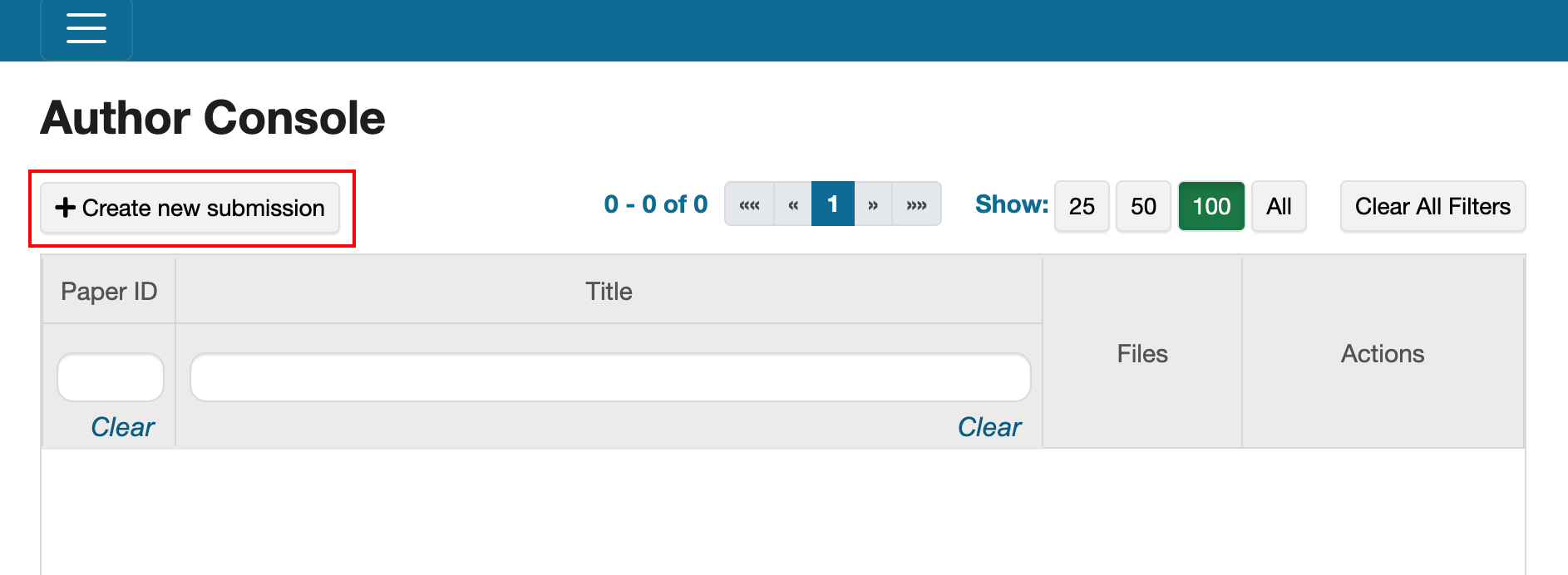
CMT Create New Submission

Submit Paper


Camera-Ready Guidelines

Please note that it is mandatory that authors must address all the changes suggested by the reviewers (if any). Authors must follow the three steps below to complete their camera-ready submission.

Step 1: IEEE-Xplore-Compatible PDF Generation

Authors must convert their paper to PDF format and verify its compatibility using the IEEE PDF eXpress tool available at ieee-pdf-express.org.

To use the tool, create an account with the following details:

  • Conference ID: 71029X
  • Your email address
  • A password of your choice

Previous users of IEEE PDF eXpress should use the same username and password as used for previous conferences. After uploading your paper, you will receive an email indicating whether the file has passed or failed validation. Your paper must pass validation before proceeding to the next step.

Step 2: Camera-Ready Paper Submission

Once you have an IEEE Xplore-compatible PDF, log in to Microsoft CMT and go to the Author Console. Select "Create Camera Ready Submission", upload your validated PDF file, and click Submit.
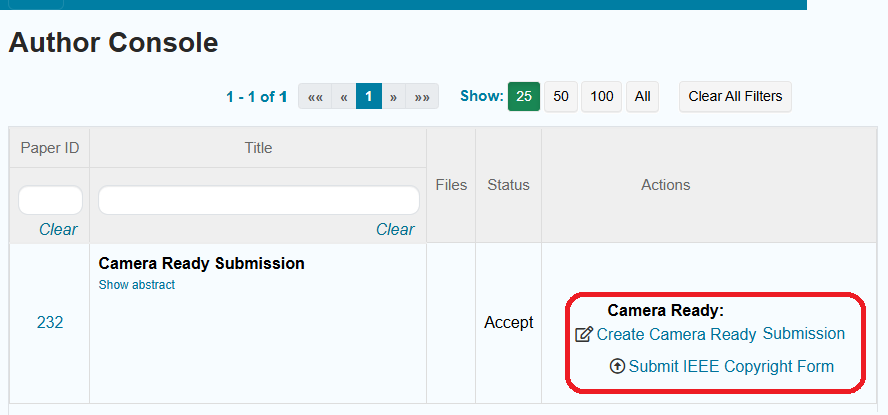
Creating camera-ready submission and IEEE Copyright Form submissions in Microsoft CMT
Figure 1: Creating camera-ready submission and IEEE Copyright Form submissions in Microsoft CMT.

Step 3: IEEE Copyright Transfer Form Submission

To enable inclusion of your paper in the conference proceedings and IEEE Xplore, at least one author must complete the IEEE copyright transfer form. This can be done directly through Microsoft CMT by providing the corresponding author's details.
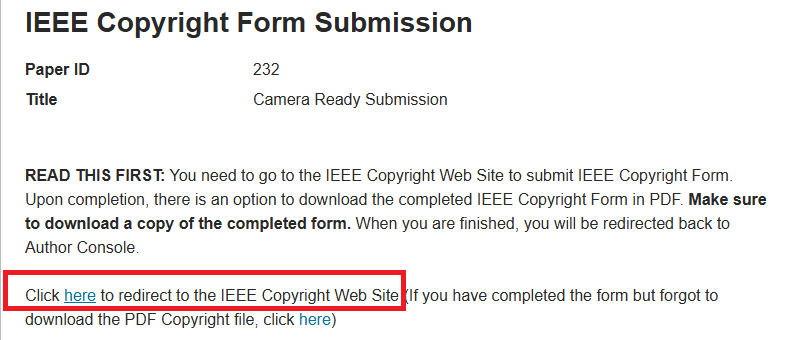
Accessing the IEEE Copyright Transfer form in Microsoft CMT
Figure 2: Accessing the IEEE Copyright Transfer form in Microsoft CMT.

Submit Camera-Ready Paper

How to Upload Camera-Ready Materials via CMT

Follow these steps to complete your submission on Microsoft CMT

1
Log in to your CMT author account at the conference submission portal.
2
In Microsoft CMT, navigate to Author Console, and click on "Create Camera-Ready". You may also select "View Reviews" to address reviewer comments before finalising.
3
Upload the required file:
  • The IEEE Xplore-compatible PDF approved by IEEE PDF eXpress (Conference ID: 71029X)
4
Confirm all files are correctly uploaded and click "Submit".
Camera-ready submissions will not be accepted via email.

How to view reviewer comments in CMT: In Author Console, open your submission and click View Reviews to read reviewer feedback before finalizing updates. You can also Create Camera-Ready or Edit Camera-Ready from the same CMT submission area.

Camera-Ready Submission Checklist for Authors

Please go through every point carefully before uploading your files to CMT.

Template & Format Compliance
Use the official IEEE conference template. Do not alter margins, column widths, line spacing, or fonts — all are prescribed by the template.
Use the A4-size IEEE template (this conference). Do not use the US letter-size version.
Paper must not exceed 5 pages in IEEE two-column format. Additional pages will incur an extra charge.
Do not add page numbers anywhere in the paper — the template handles pagination.
If you used the IEEE template as-is to draft your paper, ensure all placeholder/sample text (e.g., "This electronic document is a live template…") has been removed before submission.
Title & Author Information
Paper title does not contain symbols, special characters, footnotes, or math.
Author names must be final, correct, and written consistently. Do not include titles such as Dr., Prof., Professor, PhD, Engr., Mr., or Ms. in the author line. Check spelling, order, and sequence of authors before submission.
Author names are listed left to right, then continuing on the next line — not grouped by affiliation or listed in columns.
Each author's affiliation block must follow the IEEE 5-line format: (1) Given Name Surname, (2) Department, (3) Organisation, (4) City, Country, (5) Email or ORCID.
Affiliations are kept succinct — departments of the same organisation are not differentiated.
For more than 6 authors, names are added horizontally and continue to a third row if needed.
Abstract & Keywords
Abstract does not contain symbols, special characters, footnotes, math, or citations.
Abstract uses the run-in head style beginning with "Abstract—" in italic.
Keywords are listed after the abstract, prefixed with "Keywords—".
Text & Content Structure
Section headings use the correct IEEE styles (Heading 1–4 for text heads; Heading 5 for Acknowledgment and References). Do not number headings manually.
Abbreviations and acronyms are defined at first use in the text — even if already defined in the abstract. Common ones (IEEE, SI, MKS, etc.) do not need defining.
Abbreviations are not used in the title or headings unless unavoidable.
SI (MKS) or CGS units are used as primary units. Mixed SI/CGS units are avoided. Spellings and abbreviations of units are not mixed (e.g., use "Wb/m²" or "webers per square meter", not both).
Zero is used before decimal points: "0.25" not ".25".
No hard tabs used; hard returns limited to one per paragraph end. No extra spacing or pagination added manually.
There is no period after "et" in "et al." — and "i.e." and "e.g." are used correctly.
Figures & Tables
Figures and tables are placed at the top or bottom of columns — not in the middle. Large figures/tables may span both columns.
Figure captions are placed below the figure; table titles (heads) are placed above the table.
Figures are referenced in the text before they appear and labelled as "Fig. 1" (even at the beginning of a sentence).
Figure labels use 8 pt Times New Roman. Axis labels use full words (not abbreviations or symbols alone), with units in parentheses, e.g., "Magnetization (A/m)".
Graphics are ideally 300 dpi TIFF or EPS files with all fonts embedded. Inserted using a text box for stability.
Equations & Symbols
Equations use Times New Roman or Symbol font only.
Equations are numbered consecutively. Numbers appear flush right in parentheses, e.g., (1). Refer to them as "(1)", not "Eq. (1)" — except at the start of a sentence.
Roman symbols for quantities and variables are italicised; Greek symbols are not.
All variables and symbols are defined before or immediately after first use. Equations are punctuated with commas or periods when part of a sentence.
Citations & References
Citations are numbered consecutively in square brackets, e.g., [1]. Sentence punctuation follows the bracket: "...end of sentence [2]."
References are cited as "[3]" — not "Ref. [3]" or "reference [3]", except at the start of a sentence.
All author names are given unless there are six or more — "et al." is only used for 6+ authors.
Only the first word of a paper title is capitalised in the reference list, except for proper nouns and element symbols.
Unpublished papers are cited as "unpublished"; accepted-but-not-yet-published papers are cited as "in press".
Footnotes are numbered separately in superscripts and placed at the bottom of the column in which they are cited — not in the abstract or reference list.
DOIs and online links (arXiv, GitHub, Code Ocean, etc.) are included where available, following IEEE reference style.

Reference Details and Common Mistakes: Each reference must be complete and accurate. Include full author names, complete title, journal or conference name, volume, issue, page numbers, publisher where applicable, year, and DOI where available. Incomplete or AI-generated references must be corrected before camera-ready submission.

Correct Example: Journal Paper
[1] E. Carter, M. Anderson, S. Williams, and J. Thompson, "Deep learning-based image classification for medical diagnosis," IEEE Trans. Neural Netw. Learn. Syst., vol. 34, no. 5, pp. 2210–2225, May 2023, doi: 10.1109/TNNLS.2023.0012345.
Correct Example: Conference Paper
[2] O. Martinez, D. Brown, and E. Carter, "Federated learning for privacy-preserving healthcare analytics," in Proc. IEEE Int. Conf. Artif. Intell., Blockchain, Internet of Things (AIBThings), 2026, pp. 45–52, doi: 10.1109/AIBThings.2026.0045678.
Correct Example: Online / Preprint
[3] S. Williams and J. Thompson, "Transformer architectures for real-time anomaly detection," 2024, arXiv:2401.09876. [Online]. Available: https://arxiv.org/abs/2401.09876
Incorrect Example: Incomplete Author Names Using et al.
[4] Carter et al., "A convolutional neural network model for plant disease detection." IEEE Conf., 2022.
Why this is incorrect: This reference uses "et al." instead of full author names, omits the volume, issue, and page numbers, does not include the full conference name, and is missing a DOI. The title capitalisation is also incorrect — only the first word should be capitalised.
Corrected Version
[4] E. Carter, M. Anderson, O. Martinez, and D. Brown, "A convolutional neural network model for plant disease detection using leaf images," in Proc. IEEE Int. Conf. Comput. Vision Smart Agric., Austin, TX, USA, 2022, pp. 88–99, doi: 10.1109/ICCVSA.2022.0088.
Final Quality Checks
"Acknowledgment" is spelled without an "e" after the "g" (American English). Sponsor acknowledgments appear in an unnumbered footnote on the first page.
Common mistakes checked: "data" is plural; subscripts use zero (0), not the letter "o"; "non" prefix joined to words without a hyphen.
Grammar, spelling, and scientific clarity verified. Paper has been proofread in full.
The final PDF has been validated via IEEE PDF eXpress (Conference ID: 71029X) and passed.
The paper has been submitted previously unpublished and is not currently under review elsewhere.

For any issues related to the camera-ready submission process, please contact us: info@aibthings.com


Technical Paper Guidelines

Expected structure and technical content guidelines for AIBThings paper submissions.

Title

The title should be compact, specific, and directly relevant to the research problem. It should clearly indicate the main idea, proposed method, and application area where applicable. Avoid vague, overly long, or general titles.

Abstract

The abstract should briefly summarize the problem, proposed method, major contribution, and key findings. It should be concise and focused, preferably within one short paragraph. Do not include citations, equations, or special characters.

Keywords

Keywords should be written in one line only. Include 4 to 6 relevant terms that represent the research area, method, dataset/domain, and application.

Introduction

Do not use subheadings inside the introduction. Write two to three connected paragraphs:

  • Paragraph 1: Introduce the broader research area and its importance.
  • Paragraph 2: Explain the specific research problem, limitations of existing work, and the research gap.
  • Paragraph 3: Briefly introduce the proposed work.
After these paragraphs, include a short bulleted list of research objectives and another short bulleted list of major contributions. End with a brief paper organisation paragraph.
Related Work

Do not use subheadings inside the related work section. Critically analyze at least 12–15 recent and relevant research papers. The discussion should compare methods, datasets, strengths, limitations, and research gaps. Avoid writing only descriptive summaries of papers.

A compact comparison table may be included if useful, with columns such as: Reference | Method | Dataset | Contribution | Limitation.
Materials and Methods

This section may include subsections. It should clearly explain how the research was conducted and provide enough technical detail for reproducibility.

Dataset Description

Describe the dataset source, size, features, classes/categories, data format, preprocessing steps, and any data split used for training, validation, and testing.

Proposed Methodology

Explain the complete workflow of the proposed approach from input to output. Include a block diagram, flowchart, or system architecture diagram where possible. Clearly explain each major step, model, framework, or technique used.

Algorithm or Pseudocode

If the paper includes a computational method, model pipeline, or decision-making procedure, include an algorithm or pseudocode. Clearly mention input, processing steps, and output.

Implementation Details

Briefly describe the programming language, tools, libraries, frameworks, hardware, operating system, GPU/CPU, RAM, or cloud environment used for implementation.

Experimental Results

This section should present the strongest evidence of the proposed work. It may include the following subsections:

Experimental Setup

Briefly explain how experiments were conducted. Mention dataset split, training/testing protocol, validation strategy, baseline methods, parameter settings, and hardware/software setup.

Evaluation Metrics

Select metrics appropriate to the research problem:

  • Classification: Accuracy, Precision, Recall, F1-score, Confusion Matrix, ROC-AUC, Specificity
  • Regression: MAE, MSE, RMSE, R-squared
  • Detection / Segmentation: IoU, mAP, Dice Score, Pixel Accuracy

Include formulas where necessary.

Results and Comparative Analysis

Clearly present results using tables, figures, graphs, confusion matrices, or qualitative examples. Compare the proposed method with baseline methods. This part must clearly show the improvement, effectiveness, or usefulness of the proposed method.

Error Analysis and Discussion

Discuss failure cases, limitations, unusual results, and technical reasons behind observed performance. Do not only repeat values from tables. Explain why the method performed well or poorly and what the findings mean.

Conclusion

Write the conclusion as one compact paragraph. It should summarize the research problem, proposed approach, major achievements, and significance of the results. Mention future work briefly within the same paragraph. Do not create a separate Future Work section.

References

References must follow IEEE numerical citation style. Each reference should include complete details: author names, paper title, journal or conference name, volume, issue, pages, year, DOI, and URL where available. References must be numbered in the order they appear in the paper.

[1] A. Author, B. Author, and C. Author, "Title of the research paper," Journal Name, vol. 10, no. 2, pp. 100–110, 2024, doi: 10.xxxx/xxxxx.
[2] A. Author and B. Author, "Title of the conference paper," in Proc. International Conference Name, City, Country, 2023, pp. 50–55, doi: 10.xxxx/xxxxx.
[3] A. Author, "Title of online article or technical report," Organization or Publisher Name, 2024. [Online]. Available: URL

Presentation Guidelines

All authors are requested to carefully follow the guidelines below while preparing their presentation slides for AIBThings. These guidelines apply to both in-person and online presenters.

Presentation time allocation:

  • In-person presentations: 20 minutes total, with 12–15 minutes for the presentation followed by 2–5 minutes for Q&A.
  • Online presentations: 15 minutes total, with 10–12 minutes for the presentation followed by 1–3 minutes for Q&A.
  • Google Meet links for online presenters will be included in the conference program.
  • It is mandatory to present your paper at the conference. Any paper not presented will not be included for indexing in IEEE Xplore.
  • The conference spans two days. Different sessions will be arranged, and you will present your paper live in your assigned session.
  • Each session will be moderated by a respective session chair, who will invite presenters in the sequence provided in the conference program.
  • The communication language used both during the presentation and the Q&A session must be English.
  • The presentation should ideally contain 10–12 slides only, with roughly 1 minute of content per slide.
  • Keep slides simple, clear, and professional:
    • Avoid long paragraphs
    • Use concise bullet points
    • Use readable font sizes
    • Minimise animations and transitions
    • Ensure all figures, tables, and charts are high quality and clearly visible
  • We encourage you to include the AIBThings conference logo and title on your slides.
Recommended Slide Structure
  1. Title slide with author information
  2. Introduction and motivation
  3. Research objectives and key contributions
  4. Materials and methodology
  5. Results and discussion
  6. Conclusion and future directions
  7. Q&A
Additional Requirements for Online Presenters
  • Ensure a stable internet connection before the session begins.
  • Use quality audio equipment — a headset or external microphone is recommended.
  • Have a power backup ready to avoid interruptions.
  • Present from a quiet environment free from background noise.
  • Join your session at least 10 minutes early with your presentation ready in both PowerPoint and PDF formats.

Publication Ethics & Indexing

Accepted papers will be submitted for inclusion into IEEE Xplore subject to meeting IEEE Xplore’s scope and quality requirements.To ensure that your paper gets indexed in IEEE Xplore, one of the most prestigious academic databases, it is essential to adhere to the following guidelines and quality requirements:

  • Formatting and Submission:Format your paper according to the conference's submission guidelines and template.
  • Originality and Plagiarism:Ensure that your paper presents original work and has not been published elsewhere. Plagiarism is a serious offense in academic publishing and can lead to rejection from IEEE Xplore. Use appropriate citation and referencing for all sources and ideas.
  • English Language: Use clear and concise English language in your paper. Poorly written papers with grammar or language issues may be rejected.
  • Copyright and Consent: Ensure you have the necessary rights to publish the paper. If your paper includes content (e.g., figures, tables) from other sources, make sure you have obtained the appropriate permissions for reuse.
  • AI-Generated Content: Submissions must be original. Any AI-generated content that violates originality or plagiarism policies may result in exclusion from the proceedings. Strict publication ethics are enforced.

Review Process

  • All submitted papers will be reviewed by at least 2 independent reviewers. Additional reviewers will be consulted if required.
  • All papers will go through plagiarism checker. Plagiarism report must not exceed 15%
  • All papers must be formatted according to the given IEEE Conference Template.
  • Paper acceptance will be based on originality, significance, technical soundness, and clarity of presentation.
  • Authors must make sure that they submit previously unpublished papers to this conference.